Leveraging AI to Democratize Technology

AI tools are known for generating large amounts of (sometimes questionable) code. I’ve contributed my share. What interests me more, as of now, is their ability to transform things: prose into rhyme, text into sound, and, for what concerns us today, company processes into tools and documentation.
I’ve made it no secret that I work at AnchorLess, the cutting-edge relocation startup your grandma won’t stop talking about at bridge club.
You see, we’re a very agile team, and as such, everyone does a little bit of everything. While meandering through our DevOps repository, I found the cruft left behind by every successive rework of our dev, staging and production environments. The mess cost us several minutes of wasted build time at every staging deployment, and untangling it was a project of its own.
So I did the only sensible thing and ran to Claude, certain he’d know how to clean this up. He did, of course. Explaining the issue to my boss was another matter. The best way to show redundancy and wasted resources, I figured, was a picture. After all, who doesn’t love a good UML diagram?
Infrastructure lends itself well to diagrams, and I could whip up a proper interactive one: good old JS files I haven’t read, mirroring the state of our bash scripts.
I wish I could show you, but our internal infrastructure isn’t going on this blog just yet. Regardless, the diagrams convinced my boss that refactoring our pipeline was a worthy endeavor, probably thanks to the sheer number of arrows rushing out to lost containers floating into the ether on some remote Hetzner server.
After this little stunt, I realized: it had taken me almost no time to produce the evidence I needed, and that evidence made the why far easier to communicate than I expected. If Claude could do that so easily, couldn’t we generate the documentation we need directly from our code?
We deal with a lot of government applications on the daily, and the pattern that suits them best is almost always the state machine.
A state machine describes a process as a finite set of states and the transitions allowed between them. Whatever you’re modeling sits in one state at a time, and it moves along a path you’ve defined in advance. An application might go from submitted to under review to approved or rejected, and never jump straight from submitted to approved.
We’ve built our own version of the Spatie state machine package, which means we’re free to extend it as we please. A few extra attributes later, every transition carried a label explaining in plain prose what it does, and why one path gets taken rather than another.
While this might be overkill for simpler cases, it pays off on larger ones, such as a joint bank account application. Telling at a glance what step an application is in, and where it goes next, helps the tech team implement the feature, the product team see the constraints, and the support team work out where a given customer actually is.
What comes out looks something like this:
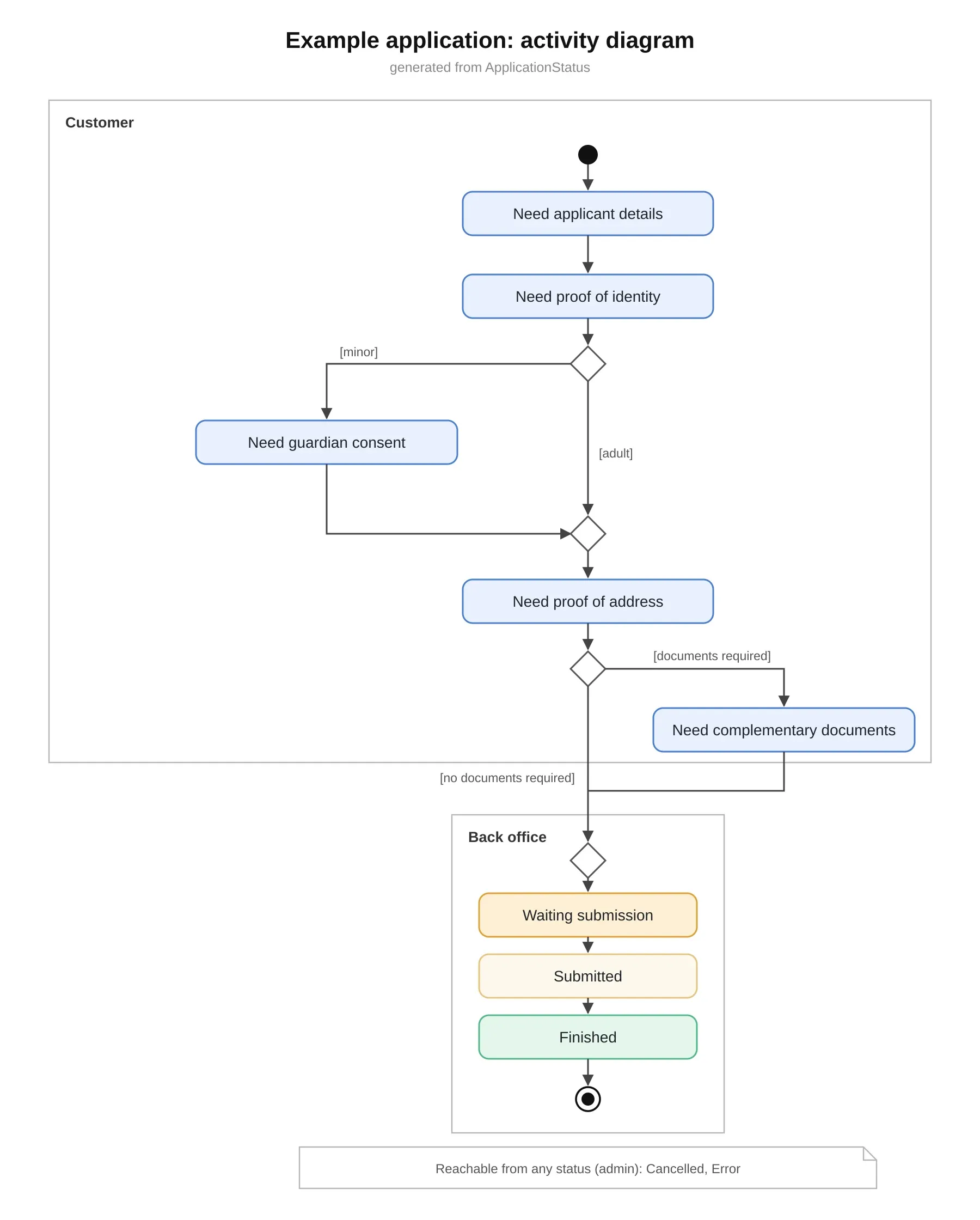
Why stop at an image, though? Wouldn’t it be great if the diagram were interactive? What if we attached email templates or file operations to certain statuses? Extending the codebase like this is a powerful pattern: it makes the system self-documenting and actionable. Your company stops being an assembly of processes and becomes a self-sustaining system.
Developers have long been the main bottleneck in most companies. An idea has to pass through them to become anything more than a Figma frame or a Photoshop mockup.
With AI, that bottleneck is finally widening. Anyone on the team can meaningfully contribute to the product, provided they have the right context and proper guardrails.
Generating UML diagrams isn’t really the point of this article. The point is that everyone can now add to a company’s tech stack, whether or not they were trained to. Documentation can be tailored to them and the way they actually work, and tools can be built to amplify their strengths, be it agents, workflows, or whatever comes next.
Let me give you another example: we recently set up Storybook to present our components and the states they can be in. The product team’s Claude instance now knows which Figma node maps to which React component in our codebase, and what interaction triggers what change.
Because our state machine is clearly defined, every Figma frame in an application carries the name of the step it belongs to. From that single entry point, you can find everything else tied to that step: its design, its database table, its transitions in our backend, its customer emails, and its component in our frontend.
This doesn’t just let a small team like ours move faster. It gives every member the confidence that they can contribute something meaningful to others. And it makes communication easier, since everyone works from the same reference when discussing a new feature, a bug fix, or an improvement. Most importantly, it lets everyone take part in a process that was until now reserved for a few.
While I wish I could keep going on this fascinating topic, I’ll have to leave you here. You see, I have a plane to catch. Stay tuned though: I might publish an article about Domain-Driven Design in the same vein.
I told you, I’ll write the article. In the meantime, Wikipedia is a decent place to start.
A cracked Photoshop, a Blogspot full of hand-drawn buttons, and the slow drift that turned code into a job. On losing the magic of computers, and getting it back.
6 min readWhile observability has always been essential, it is now a lever for producing better code faster. Sentry picks the wound, Opus writes the stitches, and a human decides every morning whether to merge them.
10 min read